Why Should the Dental Chair Have to Stay in the Dental office?
Why Should the Dental Chair Have to Stay in the Dental Office?
The Growing Need for Mobile and Portable Dentistry
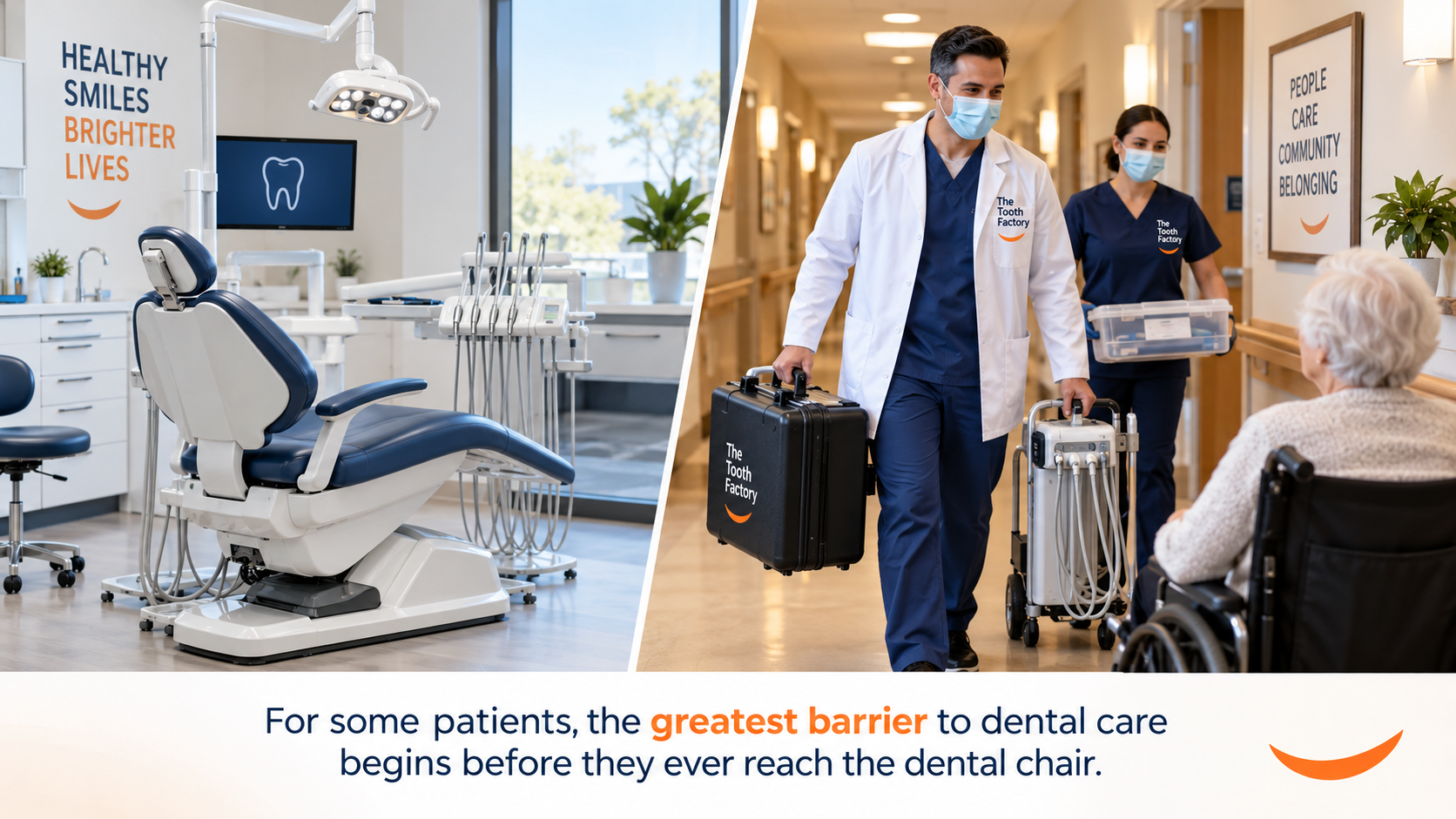
For millions of people, accessing dental care is not simply a matter of booking an appointment. Age, disability, transportation, geography, dependence on caregivers, and medical complexity can make reaching a traditional dental office surprisingly difficult.
Mobile and portable dentistry offer a simple but powerful idea:
Instead of always asking the patient to come to the dental clinic, perhaps sometimes the dental clinic should come to the patient.
Think about the traditional dental appointment.
- You notice a problem.
- You call the office.
- You arrange transportation.
- You travel to the clinic.
- You transfer into the dental chair.
- You receive treatment.
- You travel home.
For many of us, these steps happen almost automatically.
But now imagine you are 92 years old.
You live in a long-term care facility. You use a wheelchair. You require assistance transferring. You may have dementia or multiple medical conditions. A family member may need to take time away from work to accompany you. Accessible transportation has to be arranged. Your medications and medical history need to travel with you.
Suddenly, the “simple dental appointment” becomes a small logistical expedition.
What if the problem is not that patients are failing to reach dentistry?
What if dentistry has been designed around the assumption that every patient can reach us?
The Access Problem Is Real
Canada has made major progress toward addressing the financial barrier to dental care through programs such as the Canadian Dental Care Plan.
But affordability is only one part of access.
Where a person lives, their physical ability, transportation options, income, medical condition, and level of independence can all influence whether they actually receive dental care.
Canadian oral-health data continue to show differences in dental attendance between urban and rural populations, with some rural, lower-income, and older populations experiencing greater barriers to receiving regular care.
Dental insurance can help someone pay for care.
But an insurance card cannot drive a frail resident to the dental clinic.
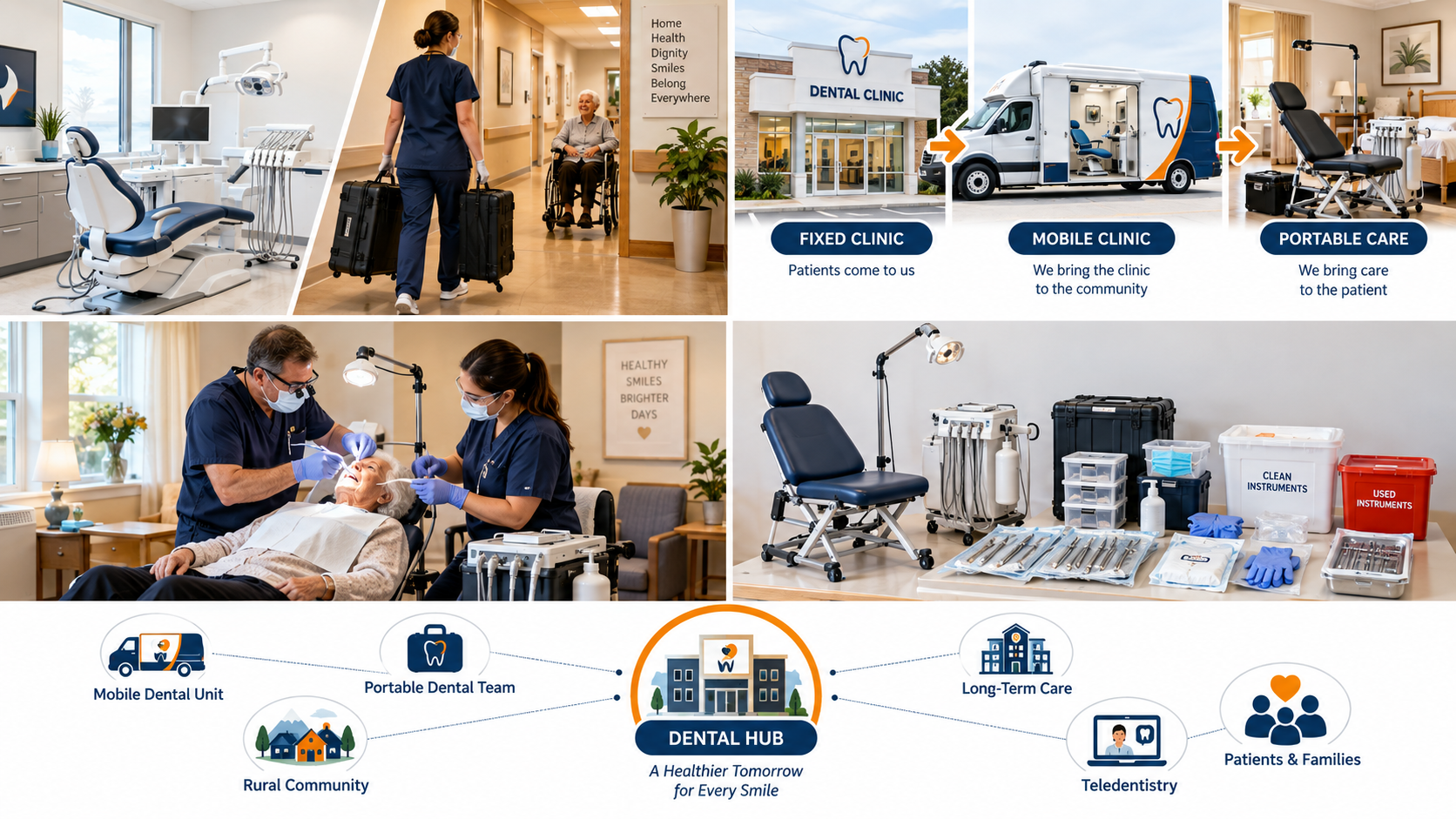
Mobile Dentistry and Portable Dentistry Are Not Exactly the Same
Mobile Dentistry
A mobile dental clinic generally brings a dental operatory to a community using a specially designed vehicle, trailer, or other mobile unit.
Think: dental clinic on wheels.
The unit may contain a dental chair, delivery systems, suction, radiography, storage, and other clinical equipment. The patient enters the mobile clinic and receives care there.
Portable Dentistry
Portable dentistry takes the idea one step further.
Instead of bringing a vehicle containing the clinic near the patient, portable equipment allows the dental team to bring selected parts of the operatory directly inside a long-term care facility, retirement residence, community centre, school, remote community, or other appropriate care environment.
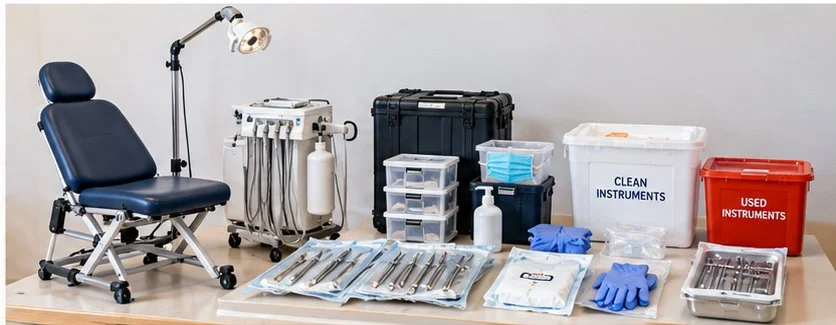
Portable equipment can include compact dental chairs, examination lights, suction systems, delivery units, instruments, protective barriers, and appropriately designed diagnostic equipment.
Mobile dentistry moves the clinic.
Portable dentistry moves the dental equipment.
And sometimes, you need both.
Why Portability Matters
A dental van can solve distance.
But it does not always solve mobility.
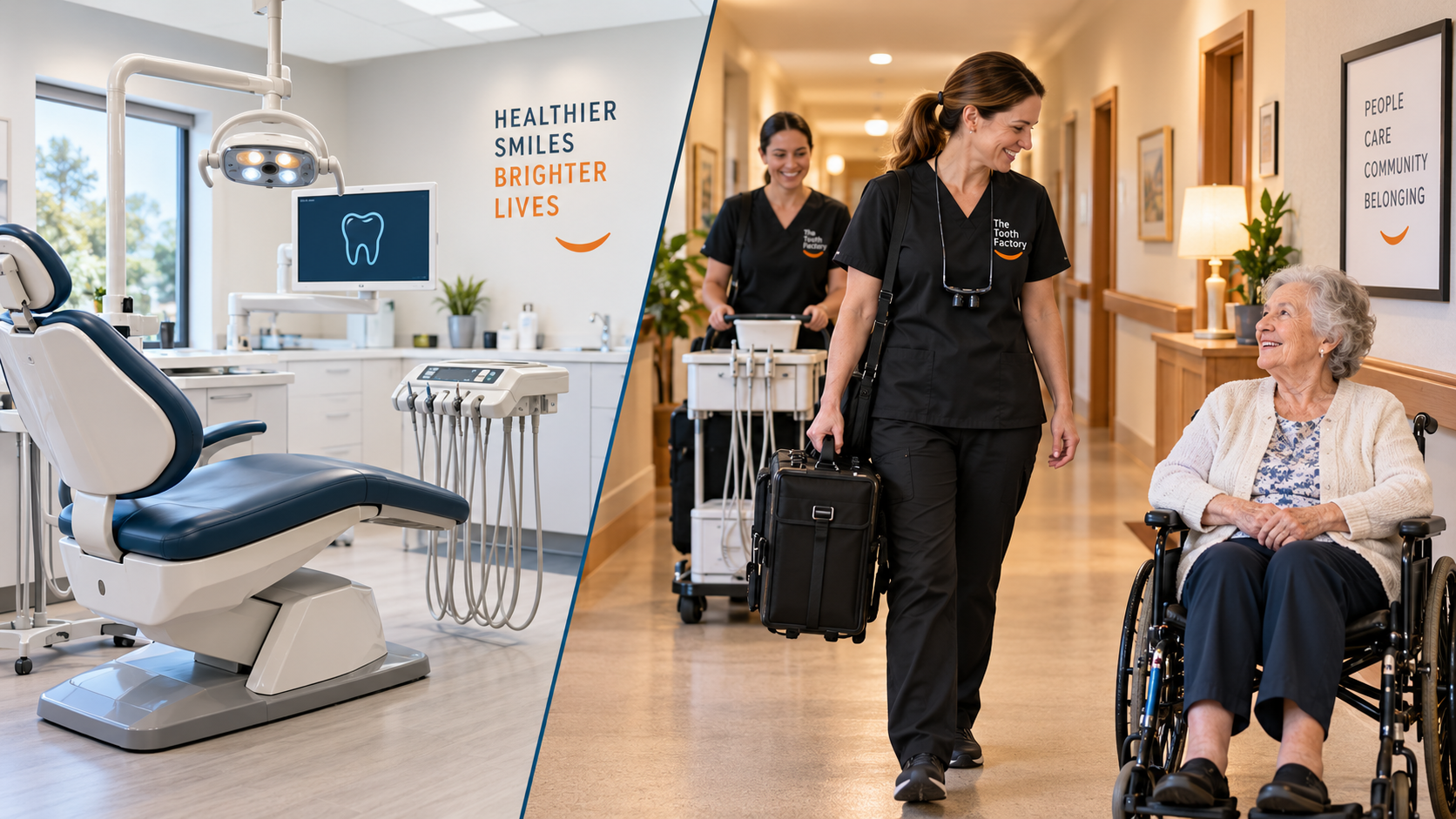
Imagine a mobile dental unit parked outside a long-term care home.
For an independent resident, that may work beautifully.
For another resident who is bedridden, severely frail, medically complex, or unable to transfer safely, the van may still be surprisingly far away.
The distance may only be 30 metres.
Functionally, however, it could be 30 kilometres.
That is where portable dentistry becomes powerful.
Instead of transporting a medically vulnerable person through an already complicated system, selected forms of dental care may be delivered where that person already lives.
Long-Term Care May Be Where the Need Is Most Obvious
The long-term care population provides one of the clearest examples of why dentistry may need to become more portable.
We are living longer.
We are keeping our teeth longer.
That is good news.
But it also means that more people are entering frailty with natural teeth, crowns, bridges, implants, partial dentures, complex medical histories, reduced dexterity, and cognitive impairment.
Those mouths still require care.
The old image of aging as simply “eventually everyone gets dentures” no longer reflects the complexity of modern geriatric dentistry.
The Mouth Does Not Retire When the Patient Enters Long-Term Care
Moving into long-term care does not make cavities disappear.
Plaque does not recognize retirement.
Dentures still accumulate biofilm.
Teeth can still fracture.
Gums can still become inflamed.
Dry mouth can still occur.
Oral infections can still develop.
And oral pain can still affect eating, sleeping, communication, and quality of life.
For vulnerable older adults, oral healthcare is not simply cosmetic. It is part of maintaining comfort, function, dignity, and quality of life.
What Can Portable Dentistry Actually Do?
This is where expectations need to remain realistic.
Portable dentistry does not mean attempting every dental procedure beside someone's bed.
Different jurisdictions have different professional, facility, infection-control, radiographic, and equipment requirements. Every treatment decision must still depend on the patient's medical condition and clinical needs.
Appropriately designed portable dental services may potentially support selected forms of examination, oral-health screening, preventive care, dental hygiene, fluoride therapy, denture assessment, urgent-care assessment, triage, radiographic assessment where permitted, and certain straightforward procedures when clinically appropriate.
More complex treatment may still require a conventional dental clinic, hospital environment, specialist service, or appropriately equipped mobile operatory.
The goal is not:
“Do absolutely everything anywhere.”
The goal is:
“Do the right care in the right place.”
Portable Does Not Mean Lower Standard
This point is critical.
A portable dental clinic should not mean “dentistry with a folding chair and a toolbox.”
The same fundamental professional responsibilities remain. A legitimate portable-care system still needs to consider infection prevention and control, sterilized instruments, separation of clean and contaminated equipment, appropriate clinical barriers, medical histories, informed consent, privacy, documentation, emergency preparedness, sharps management, waste disposal, equipment maintenance, radiation safety where applicable, patient positioning, and appropriate referral pathways.
A well-designed portable system should feel less like improvisation and more like a dental operatory that has been engineered to travel.
The location may change.
The professional standard cannot.
What Would the Ideal System Look Like?
Imagine a long-term care facility partnered with a local dental network.
Every new resident receives an oral-health assessment.
Caregivers receive practical oral-hygiene training.
Residents are screened periodically.
Potential problems are digitally triaged.
A portable dental team visits residents who require examination or selected treatment.
Complex cases are transferred to a partner dental clinic.
Dental information moves securely between the facility and the dental team.
Now multiply that system across:
10 facilities.
100 facilities.
1,000 facilities.
Suddenly portable dentistry stops looking like an unusual service. It starts looking like healthcare infrastructure.
The Biggest Question
When someone cannot reach a dentist, we traditionally describe that person as having an “access problem.”
But perhaps healthcare systems should ask a different question:
How much effort have we made to reach them?
Dentistry has undergone extraordinary technological change.
We have digital scanners, CBCT, CAD/CAM, guided surgery, implants, artificial intelligence, and 3D printing.
Yet one of dentistry's most meaningful innovations may ultimately be surprisingly simple:
Putting wheels under the clinic.
And handles on the equipment.
The Tooth Factory Takeaway
Mobile and portable dentistry will not replace conventional dental offices.
Nor should they.
But they may become an increasingly important extension of them.
Our population is aging. More older adults are retaining natural teeth. Rural and underserved communities continue to face barriers. Long-term care residents have substantial oral-health needs. People with disabilities and mobility limitations may encounter obstacles that cannot be solved by insurance coverage alone.
The future of dentistry may therefore require us to stop thinking of the dental clinic as only a place.
A dental clinic is really a trained team, appropriate equipment, infection control, diagnostic ability, clinical judgment, documentation, and the ability to provide safe care.
If those things can travel safely and responsibly, perhaps dentistry can travel too.
Because sometimes the patient needs to come to the dental chair.
And sometimes... the dental chair needs to come to the patient.
About The Tooth Factory
The Tooth Factory is committed to making dentistry easier to understand while exploring ideas that may improve the future of oral healthcare.
We publish two free dental-health education and oral-health promotion articles every week.
www.thetoothfactory.ca
YouTube: @TheToothFactory
References & Further Reading
1. Government of Canada. Canadian Oral Health Survey — Access to Oral Health Care.
2. What Do We Know About Portable Dental Services? A Scoping Review. Gerodontology.
3. Oral Health Status of Long-Term Care Residents in Canada: Results of a National Cross-Sectional Study.
4. Canadian research examining oral-health assessment and daily oral-care practices in long-term care.
5. Systematic reviews examining professional oral care and respiratory-health outcomes among dependent older adults.
6. Systematic reviews examining teledentistry and access to oral healthcare.
7. Journal of the Canadian Dental Association — published discussion of mobile dental services for long-term care environments.

