AI in Dentistry: Is Your Dentist About to Get a Digital Co-Pilot?
From X-rays that can highlight suspicious areas to virtual assistants, smarter treatment planning and AI-powered dental education, artificial intelligence is quietly moving into dentistry. But will it replace your dentist—or simply make your dentist better?
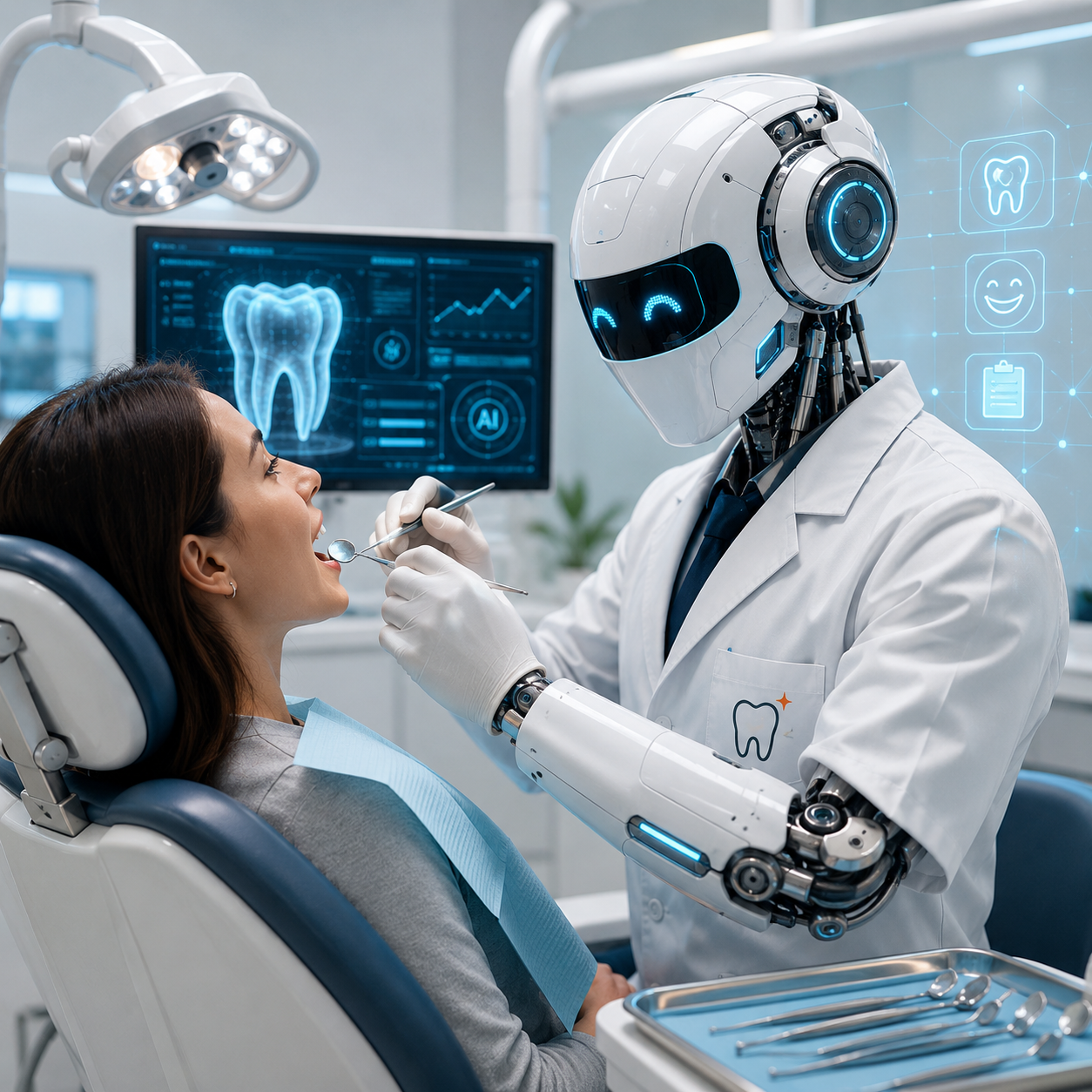
Imagine walking into a dental office ten years from now.
You sit in the chair.
A digital scan of your mouth appears almost instantly.
Software compares today's images with your previous records and quietly points out an area where the bone level may have changed.
Another system organizes your X-rays.
Your dentist reviews the findings, examines you, talks through the options and develops a treatment plan.
Meanwhile, software has already drafted the clinical note, prepared your next appointment and generated an easy-to-understand explanation of what your dentist just discussed.
Sounds futuristic?
Maybe.
But parts of that future are already here.
Artificial intelligence—or AI—is rapidly entering healthcare, and dentistry is no exception. Canadian dental literature has already described applications ranging from identifying structures on radiographs and detecting disease to predicting treatment outcomes, supporting dental laboratories and contributing to dental education. [1]
So grab your imaginary robot toothbrush.
Let's find out what AI may actually mean for your next trip to the dentist.
First Things First: What Exactly Is AI?
When people hear artificial intelligence, they often imagine a humanoid robot wearing scrubs and holding a dental mirror.
Fortunately—or unfortunately, depending on how much you like science-fiction movies—that isn't really what we mean.
AI refers broadly to computer systems capable of performing tasks that normally require aspects of human intelligence, such as:
recognizing patterns
analyzing images
interpreting language
predicting outcomes
organizing information
generating text or images
assisting with decisions
A particularly important form of AI in dentistry is machine learning.
Instead of programming a computer with one rigid rule after another, developers can train algorithms using large amounts of data so that the system becomes better at recognizing patterns.
Show an appropriately designed system thousands upon thousands of dental images, for example, and it may learn patterns associated with particular findings.
The computer is not suddenly becoming a dentist.
Think of it more like giving your dentist a very fast digital assistant with an extraordinary ability to analyze patterns.
And unlike your dentist after a long Monday afternoon...
the computer doesn't need coffee.
1. Dental X-Rays May Be AI's Biggest Early Playground
Dental offices generate enormous quantities of images:
bitewing radiographs
periapical radiographs
panoramic radiographs
CBCT scans
intraoral photographs
digital impressions
Historically, dentists interpret these images using their education, clinical experience and knowledge of the patient.
AI adds another set of digital eyes.
Researchers have trained algorithms to assist with tasks such as:
identifying and numbering teeth
detecting possible dental caries
identifying periodontal bone loss
recognizing periapical abnormalities
locating anatomical structures
identifying certain sinus abnormalities
assisting with image segmentation and measurements
A 2024 overview published in Evidence-Based Dentistry found that recent AI models showed promising performance when analyzing panoramic radiographs, particularly for tooth identification and numbering, while also demonstrating potential in areas such as caries detection and periodontal bone loss. Importantly, the authors warned that studies were heterogeneous and that results need to be interpreted carefully. [2]
That last sentence matters.
AI highlighting an area does not automatically mean:
“Congratulations! The computer found a cavity.”
The dentist still has to consider:
your symptoms
clinical examination
previous X-rays
whether the area has changed
your caries risk
the limitations of the image
other possible explanations
The exciting possibility is therefore not:
AI replaces diagnosis.
It is:
AI helps make sure the dentist doesn't overlook something worth investigating.
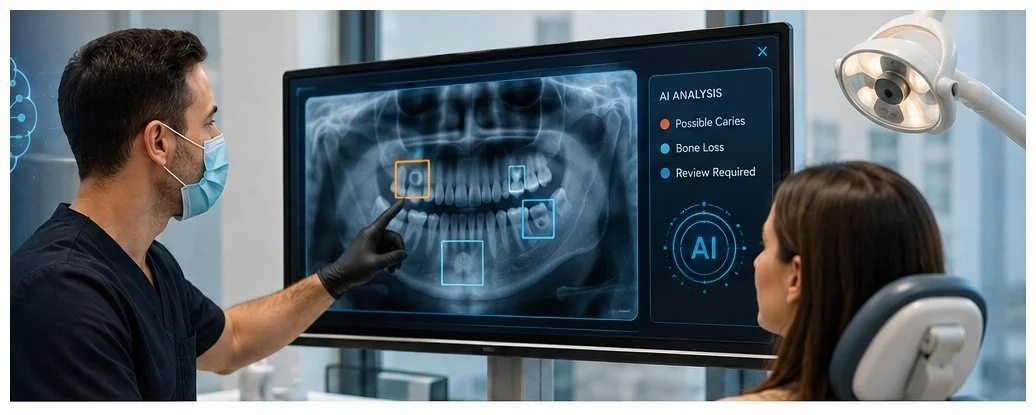
Caption:
AI can act as a digital second set of eyes, highlighting areas on dental images that may deserve closer examination.
2. Could AI Help Find Cavities Earlier?
Potentially.
This is one of the most heavily researched applications of AI in dentistry.
Cavities are not always gigantic black holes visible from across the operatory.
Early carious lesions can be subtle.
Radiographs themselves also have limitations, and interpretation varies depending on the image, lesion and observer.
Systematic reviews published in recent years have examined AI systems designed specifically to identify caries on dental radiographs and clinical images. The overall evidence suggests considerable potential, although performance varies between systems and studies. [2]
The future may therefore look something like this:
Dentist examines the tooth
Radiograph provides additional information
AI highlights a suspicious region
Dentist integrates all three
That combination is potentially much more powerful than asking either the human or the computer to work alone.
3. AI and Gum Disease: Measuring What the Eye Cannot Easily Remember
Here's another interesting possibility.
Imagine your dentist takes an X-ray today.
Then another one two years later.
Humans are excellent at recognizing significant differences—but tiny changes measured over time can be difficult to quantify precisely.
AI-assisted systems may eventually become increasingly useful for analyzing:
periodontal bone levels
changes between radiographs
calculus
tooth position
periodontal risk
patterns of disease progression
Instead of simply saying:
“I think the bone looks slightly different compared with your old X-ray...”
future systems may increasingly help dentists measure and visualize change.
That could make conversations with patients easier too.
You may not understand a periodontal chart full of numbers.
But a colour-coded image showing:
2026 → 2028 → 2030
and exactly where changes occurred?
That is much easier to understand.
4. Orthodontics Has Already Become Extremely Digital
If you have ever had clear aligners, digital impressions or computer-generated orthodontic simulations, you have already experienced dentistry's shift toward data-driven treatment.
AI may increasingly assist orthodontists and dentists with:
tooth segmentation
cephalometric landmark identification
treatment simulations
alignment analysis
progress monitoring
predicting tooth movement
identifying changes from patient photographs or scans
Imagine uploading a standardized progress image and having software organize how tooth positions have changed since your previous appointment.
Again, the orthodontist remains responsible for treatment.
But many repetitive measurements that once consumed clinical time can potentially become faster.
And saving clinicians time is not just about efficiency.
Every minute a dentist doesn't spend manually performing repetitive administrative or measurement tasks is a minute that can potentially be spent doing something computers remain remarkably bad at:
talking to you like a human being.
5. Prosthodontics Is Becoming a Digital Playground Too
Crowns.
Bridges.
Dentures.
Implants.
Smile design.
These areas of dentistry have been transformed by digital scanning and computer-aided design and manufacturing.
AI may increasingly assist with:
restoration design
margin identification
tooth morphology
occlusal analysis
digital denture design
virtual smile simulations
laboratory workflow
matching restorations to surrounding anatomy
A dental laboratory technician of the future may not begin every restoration from an entirely blank digital canvas.
Software may generate an initial design based on:
neighbouring teeth
opposing teeth
available space
previous anatomy
large libraries of dental morphology
Then the technician and dentist refine it.
This is a recurring theme throughout AI:
Let the machine perform repetitive pattern-heavy work. Let the professional apply judgment.
Canadian dental researchers have already identified dental laboratories as an important area of growing AI application. [1]
6. Perhaps the Biggest Revolution Won't Happen in the Dental Chair
This may surprise you.
Some of AI's biggest effects on dentistry may occur at the front desk.
Anyone who has worked in a dental office knows that dentistry involves much more than treating teeth.
There are:
appointment confirmations
cancellations
insurance questions
recalls
clinical notes
referrals
treatment estimates
scheduling
billing
laboratory communications
patient emails
phone calls
forms
Lots.
And lots.
And lots.
Of administration.
Generative AI systems may increasingly help dental teams:
draft appointment reminders
summarize information
organize communications
prepare referral letters
convert dictated information into draft clinical notes
identify incomplete records
categorize incoming requests
create patient-friendly educational material
assist with scheduling
help staff locate information more efficiently
Imagine finishing a procedure and dictating:
“MOD composite on 36, deep caries, liner placed, patient tolerated procedure well...”
and having software prepare a properly structured draft note for the dentist to verify.
That doesn't sound as exciting as a robotic dentist.
But ask any clinician who has stayed late completing charts whether they'd like help with documentation.Suddenly it sounds pretty revolutionary.
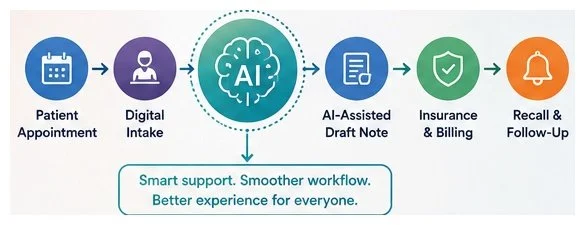
Caption:
Some of AI's biggest effects may happen behind the scenes by reducing repetitive administrative work.
7. What About Talking to Patients?
This area could become enormously important.
Dentistry is filled with complicated terminology.
Imagine hearing:
“You have an interproximal radiolucency extending through the dentinoenamel junction.”
Perfectly understandable...
if you happen to be a dentist.
AI tools may help clinicians turn complex information into patient-friendly explanations.
For example:
Dental language:
“Generalized Stage III periodontitis with horizontal bone loss.”
Patient-friendly explanation:
“The infection around several of your teeth has damaged some of the bone that supports them. We need to control the infection and closely monitor those teeth.”
AI could potentially generate:
personalized post-operative instructions
multilingual educational material
visual explanations
simplified summaries
appointment preparation instructions
treatment information written at different literacy levels
But there is a giant caveat.
The dentist must still review the information.
Generative AI can produce convincing information that is inaccurate.
In AI terminology, these incorrect outputs are sometimes described as hallucinations.
A beautifully written incorrect medical instruction is still incorrect.
That is why healthcare organizations increasingly emphasize human supervision, validation and accountability when AI is used clinically. [3][4]
8. AI Could Change Dental Education
Now things get particularly interesting for dental students.
Imagine learning crown preparation.
Instead of preparing a plastic tooth and waiting until an instructor becomes available, future simulation systems could potentially analyze:
reduction depth
taper
finish-line position
undercuts
preparation geometry
occlusal clearance
and provide immediate preliminary feedback.
The faculty member would still teach.
But the student could receive continuous objective feedback between instructor interactions.
AI may also contribute to:
adaptive question banks
personalized study plans
virtual patients
case-based learning
radiographic interpretation exercises
clinical simulation
automated formative assessment
identifying areas where a student repeatedly struggles
Canadian researchers have already identified dental education as an expanding area for AI application. [1]
The future dental student may therefore have something previous generations never had:
a tutor that never leeps.
Whether that tutor is always correct?
That's another discussion.
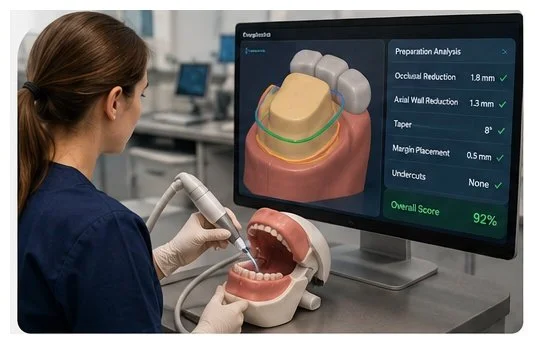
Caption:
AI could provide dental students with immediate formative feedback while instructors focus on higher-level clinical teaching and judgment.
9. Will Robots Actually Perform Dentistry?
Ah yes.
The question everyone was waiting for.
Will you eventually lie back in the dental chair while a robot says:
“OPEN WIDE, HUMAN.”
Probably not quite like that.
Dentistry is unusually difficult to automate completely.
The mouth is:
small
wet
constantly moving
filled with soft tissue
anatomically variable
attached to a person who may be frightened, uncomfortable or medically complicated
Dentists also make dozens of tiny decisions during procedures.
Tissue behaves unexpectedly.
Teeth fracture differently.
Bleeding occurs.
Patients move.
Anatomy varies.
Robotic and computer-guided technologies will likely continue developing for carefully defined procedures, but fully autonomous general dentistry presents enormous technical, ethical and regulatory challenges.
The more realistic future is robotic assistance, not robot replacement.
10. Here's the Catch: AI Can Be Very Confident and Very Wrong
This may be the most important section of this entire article.
AI has an unusual characteristic:
It can present incorrect information with extraordinary confidence.
No hesitation.
No nervous laugh.
No:
“Hmm...maybe we should double-check that.”
Just beautifully formatted nonsense.
Healthcare therefore cannot treat AI like an all-knowing oracle.
Potential problems include:
Bias
An AI system is influenced by the data used to develop and validate it.
If certain populations, imaging systems or clinical situations are poorly represented, performance may not generalize equally to everyone.
Privacy
Dental records contain sensitive health information.
Using AI does not eliminate the healthcare provider's obligation to safeguard patient information.
Explainability
Some complex AI systems can make predictions without providing a simple explanation of exactly how they reached them.
That becomes particularly important when healthcare decisions are involved.
Over-Reliance
Perhaps the biggest danger is not that AI becomes too intelligent.
It is that humans become too dependent on it.
A dentist must still be capable of questioning the software.
Accountability
If software highlights a lesion and the dentist disagrees, who decides?
The dentist.
If the software misses something?
The dentist still has professional responsibilities.
That is why the American Dental Association's current policy supports AI as a supplement to clinical judgment rather than a replacement for it, and states that clinical dental AI should be supervised by a dentist. [4]
The World Health Organization has similarly emphasized safety, ethics, transparency, accountability, privacy and equitable implementation when AI is introduced into healthcare. [5]
11. So...Will AI Replace Dentists?
Short answer?
No.
Longer answer?
AI may replace certain tasks dentists currently perform.
That distinction is incredibly important.
Consider calculators.
Calculators did not eliminate mathematicians.
Digital cameras did not eliminate photographers.
Autopilot did not eliminate airline pilots.
Technology changes what professionals spend their time doing.
A future dentist may spend less time:
manually measuring images
completing routine documentation
sorting data
creating repetitive communications
performing basic administrative tasks
and potentially spend more time:
diagnosing
treating
communicating
managing complex cases
understanding patient values
building trust
exercising clinical judgment
The dentist of the future may therefore become more human, not less.
Because machines may handle more of the machine-like work.
12. Picture Your Dental Appointment in 2035
Let's have some fun.
You walk into your dental office.
Your medical history has already been intelligently organized.
Your digital scan is compared with your previous scan.
Your X-rays are analyzed before the dentist enters—but nothing has been diagnosed yet.
The dentist examines you.
The software highlights three areas worth reviewing.
The dentist agrees with two and rejects one.
Your periodontal measurements are compared with measurements taken several years earlier.
A visual display shows exactly where your gum health has improved.
The dentist discusses treatment with you.
You ask:
“What happens if I wait?”
The system generates a visual explanation.
The dentist adjusts it based on your actual circumstances.
You choose a treatment.
Before leaving, you receive personalized instructions written in language you understand.
Your clinical documentation is drafted automatically.
The dentist reviews and signs it.
Your next visit is scheduled based on your treatment needs rather than simply:
“See you in six months because...that's what we've always done.”
That future isn't guaranteed.
But technologically, many of its individual components are already being researched or developed.
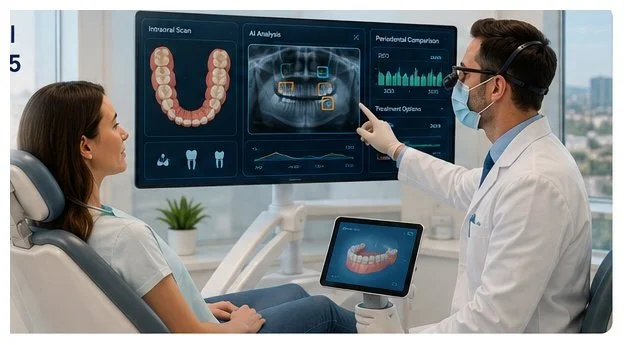
Caption:
The most realistic future is not an autonomous robot dentist—it is a human dentist supported by increasingly intelligent digital tools.
13. The Real Question Isn't “Human OR AI?”
It is:
Human + AI vs. Human Alone
The most successful AI systems in healthcare may not be the ones that attempt to replace clinicians.
They may be the ones that help clinicians become:
more consistent
more efficient
better informed
better organized
more communicative
more capable of recognizing patterns
less burdened by repetitive administrative work
The American Dental Association has begun developing formal standards and guidance specifically addressing responsible AI use in dentistry—an important sign that AI is moving from a futuristic conversation toward a genuine professional issue. [3]
What Should Patients Ask?
As these tools become more common, patients should feel comfortable asking:
“Is AI being used in my care?”
“What is it helping you evaluate?”
“Does the dentist still make the final decision?”
“How is my information protected?”
Good technology should make healthcare more understandable, not more mysterious.
What Should Dentists Remember?
AI may be extraordinary at recognizing patterns.
But it does not know your patient the way you do.
It doesn't see the nervous hand gripping the armrest.
It doesn't understand that the patient hasn't slept because their spouse is in the hospital.
It doesn't automatically appreciate why someone may choose a less ideal treatment because that is the treatment they can realistically manage.
Dentistry is not simply:
Image → Diagnosis → Procedure.
It is:
Person → Story → Examination → Evidence → Judgment → Communication → Decision → Treatment.
AI can contribute to that chain.
It should not become the entire chain:
The Tooth Factory Takeaway
Artificial intelligence is not waiting somewhere in the distant future of dentistry.
It has already entered the room.
AI is being investigated and increasingly used for:
dental imaging
disease detection
digital dentistry
laboratory workflows
education
treatment planning
documentation
administration
patient communication
And its capabilities will almost certainly continue evolving.
But the best future for dentistry is probably not one where machines replace dentists.
It is one where technology removes unnecessary work, improves consistency and gives clinicians better information—while allowing dentists to spend more of their energy doing the part that technology struggles to reproduce:
understanding another human being.
So no.
Your next dentist probably won't be a robot.
But your dentist may very well have an extraordinarily intelligent digital co-pilot sitting quietly beside them.
And used responsibly?
That could be very good news for your smile.
References
Nguyen TT, Larrivée N, Lee A, Bilaniuk O, Durand R. Use of Artificial Intelligence in Dentistry: Current Clinical Trends and Research Advances.Journal of the Canadian Dental Association. 2021;87:l7.
Webster S, Fraser J. Artificial intelligence and dental panoramic radiographs: where are we now?Evidence-Based Dentistry. 2024;25:43–44. The review described promising performance but also emphasized heterogeneity and the need for cautious interpretation.
American Dental Association. What are the standards for AI use in dentistry? The ADA describes an expanding framework of dental AI standards and responsible-use guidance.
American Dental Association. Current Policies — Artificial/Augmented Intelligence. ADA policy supports AI as an adjunct to, rather than a replacement for, dentists' clinical judgment and calls for dentist supervision, patient safety, validation, privacy protection and attention to bias.
World Health Organization. Ethics and Governance of Artificial Intelligence for Health. WHO emphasizes appropriate governance, transparency, privacy, accountability, equity and human oversight when AI is implemented in healthcare.
About The Tooth Factory
At The Tooth Factory, we believe dentistry becomes much less intimidating when people understand what is actually happening.
We publish free dental-health education, oral-health promotion and professional dental learning designed to make dentistry easier to understand.
YouTube: @TheToothFactory
