Do You Really Need to Replace a Missing Tooth? What Happens If You Don’t
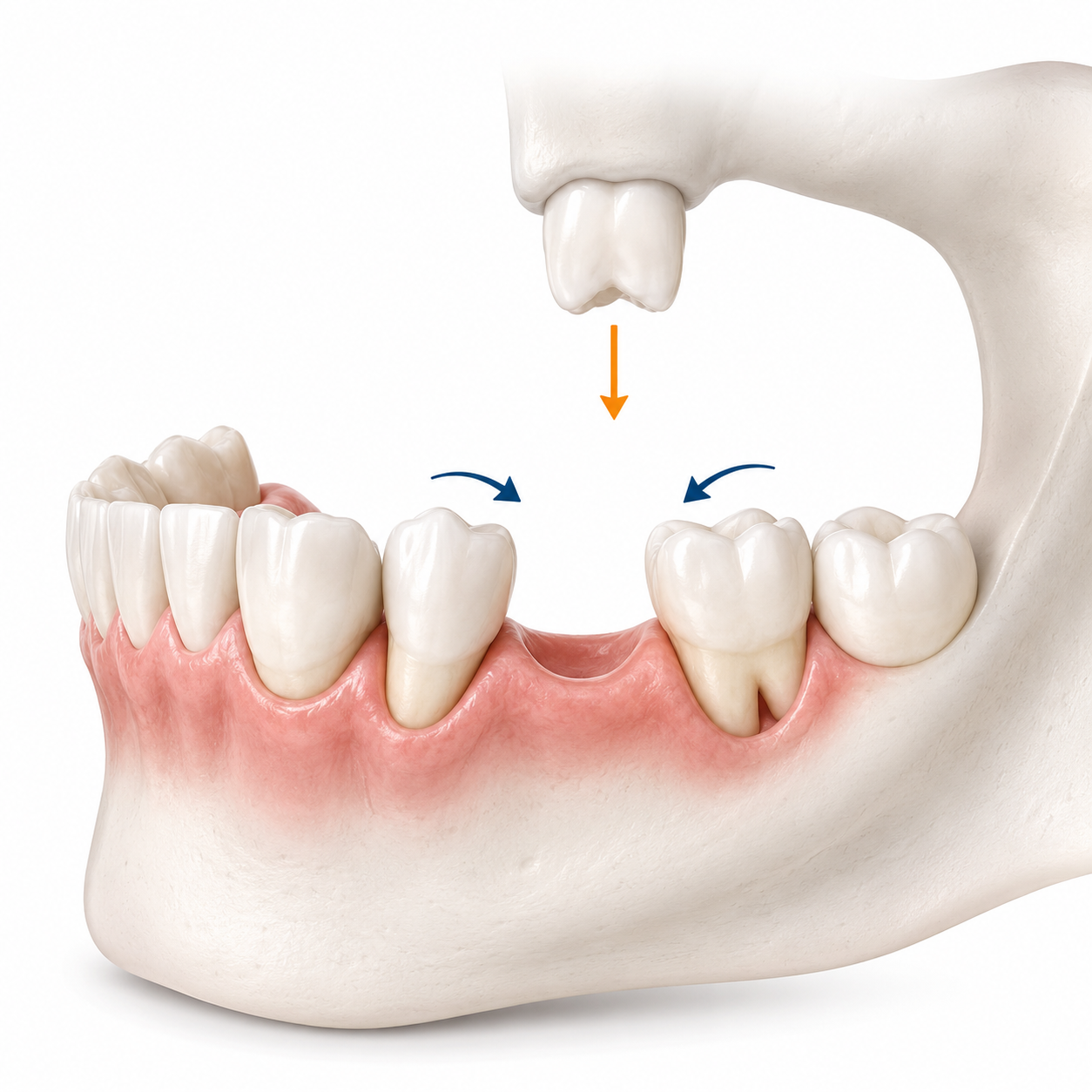
Losing a tooth can happen for many reasons.
Maybe it was removed because of a deep cavity.
Maybe it cracked.
Maybe gum disease caused it to loosen.
Or maybe you lost the tooth years ago and simply became used to the space.
If the missing tooth is not visible when you smile, it is easy to think:
“Do I really need to replace it?”
Sometimes, the answer may genuinely be no. Not every missing tooth automatically requires replacement.
But in many situations, leaving a space untreated can gradually change the way the rest of your mouth functions.
Here are some of the things that can happen.
1. Nearby Teeth Can Begin to Shift
Teeth are not permanently fixed in one position.
They are supported by bone and periodontal tissues and constantly respond to forces inside the mouth.
When a tooth is removed, the neighbouring teeth may gradually begin to tilt or drift toward the empty space.
This does not usually happen overnight.
It may occur slowly over months or years.
But once the teeth move, the space may become more difficult to restore later.
It may also change:
the way your upper and lower teeth contact
how food packs between teeth
how easy it is to clean the area
the amount of room available for a future implant or bridge
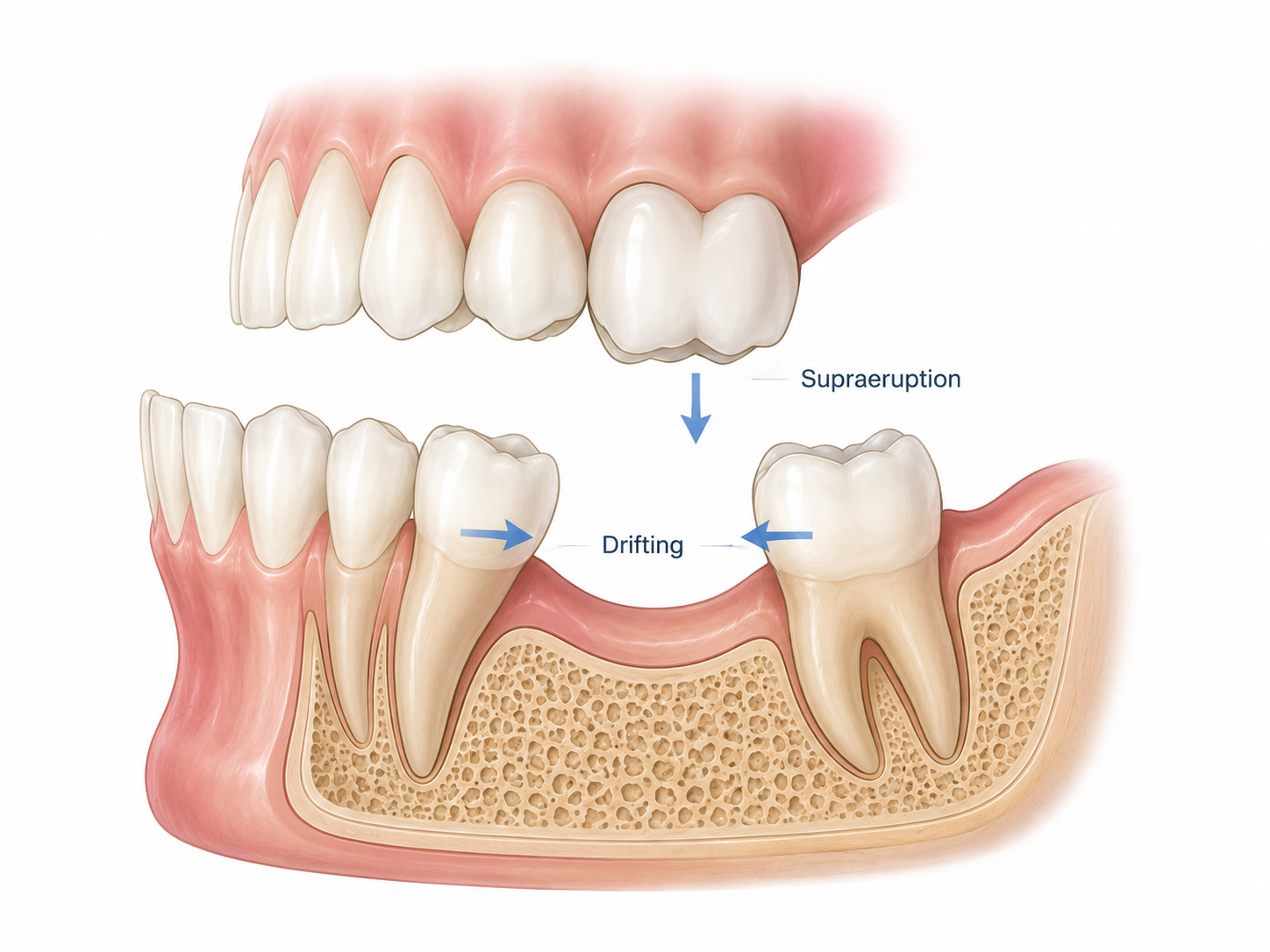
Caption:
When a tooth is missing, neighbouring teeth may gradually drift or tilt into the space.
2. The Opposing Tooth May Move Into the Space
Every tooth normally has another tooth, or group of teeth, that it contacts when you bite.
If a lower tooth is lost, the upper tooth above it may no longer have normal contact.
Over time, that opposing tooth can sometimes begin to move farther out of its socket toward the empty space.
Dentists call this supraeruption.
This can create problems because the opposing tooth may eventually interfere with:
your bite
future restorations
implant placement
the space needed to replace the missing tooth
The longer the space remains, the more complex treatment can sometimes become.
3. The Bone Around the Missing Tooth Changes
This is one of the most important consequences of tooth loss.
The jawbone surrounding your teeth is designed partly to support them and respond to the forces generated during chewing.
After a tooth is removed, the socket heals—but the surrounding bone also begins to remodel.
Over time, the bone in the area may become:
narrower
shorter
less favourable for future implant placement
This does not mean everyone who loses a tooth will experience the same amount of bone change.
Bone remodeling varies from person to person.
However, if an implant is something you may want in the future, delaying evaluation for many years can sometimes make treatment more complicated.
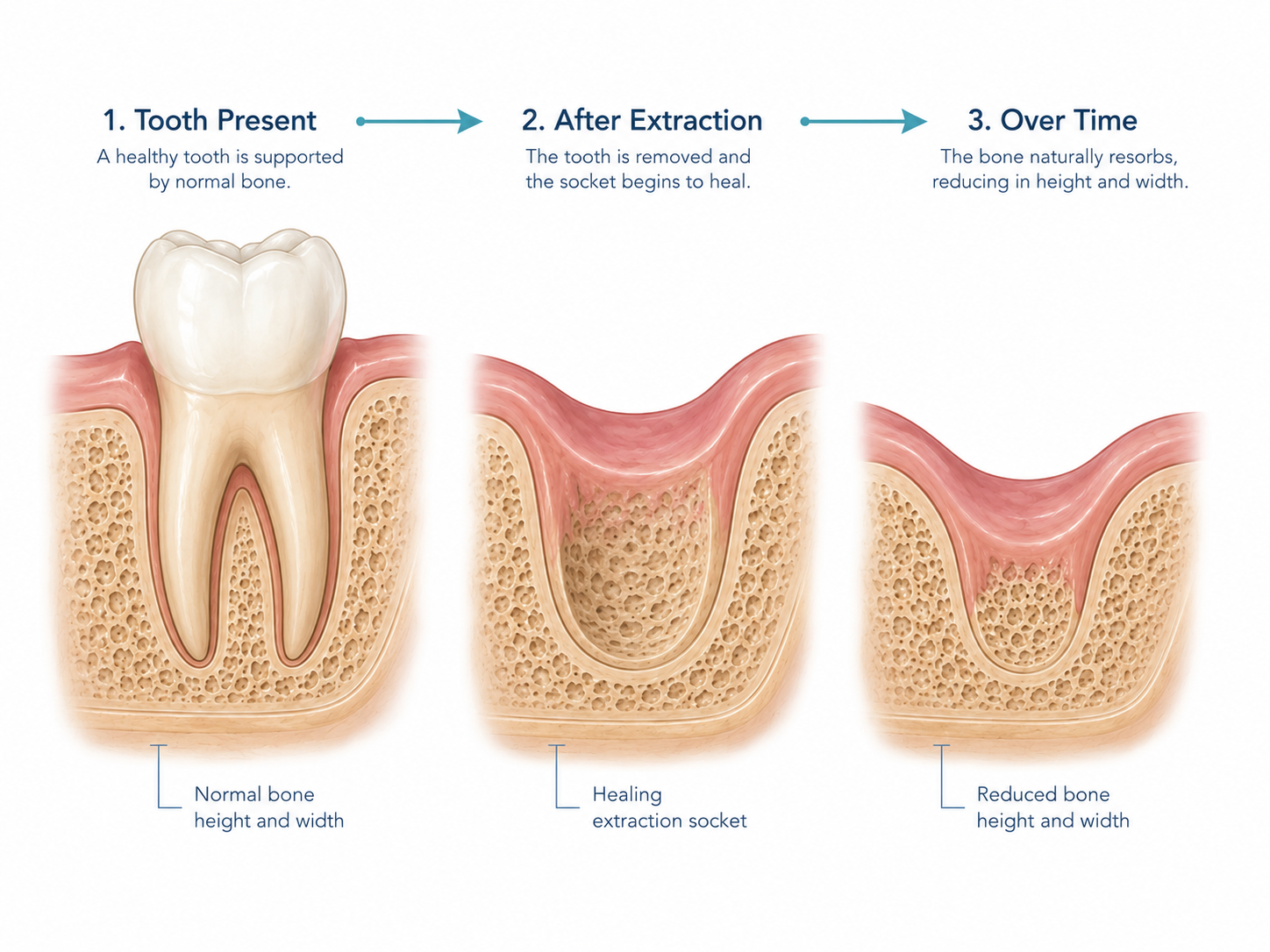
Caption:
After a tooth is removed, the surrounding jawbone gradually remodels.
4. Your Chewing Pattern May Change
People are surprisingly good at adapting.
If you lose a molar on one side, you may unconsciously begin chewing more frequently on the other side.
Initially, this may not feel like a problem.
But losing functional chewing surfaces can affect how efficiently food is broken down.
For someone missing several teeth, the effect can become even more noticeable.
Some people may begin avoiding:
nuts
fibrous vegetables
tougher meats
crunchy foods
foods that require stronger chewing
The issue is not simply appearance.
Posterior teeth play an important functional role.
5. Your Bite May Become Less Stable
Your bite is a system.
Every tooth contributes to how forces are distributed when you chew.
When one part of that system changes, the remaining teeth may begin carrying forces differently.
That does not automatically mean one missing tooth will destroy your bite.
But depending on:
which tooth is missing
how many teeth are missing
your existing bite
whether you grind your teeth
your periodontal health
the condition of the surrounding teeth
the missing tooth can contribute to a less stable bite over time.
This is why your dentist looks at the whole mouth, rather than simply asking whether there is an empty space.
6. Food Can Become Trapped More Easily
When teeth drift or tilt, their normal contact points can change.
This can create areas where food becomes trapped more easily.
Repeated food impaction can contribute to:
irritated gums
difficulty flossing
bad breath
cavities
periodontal problems
Sometimes patients notice this long before they notice any visible change in tooth position.
Does Every Missing Tooth Need to Be Replaced?
No.
This is an important point.
Dental treatment should always be individualized.
There are situations where a dentist may recommend monitoring a space rather than replacing the tooth.
The decision can depend on:
which tooth is missing
your age
the condition of adjacent teeth
your bite
the opposing tooth
your chewing ability
available bone
medical history
oral hygiene
financial considerations
your personal preferences
Wisdom teeth, for example, are routinely removed without replacement.
Other teeth may occasionally be left unreplaced if function and stability remain acceptable.
The question is therefore not simply:
“Is there a missing tooth?”
The better question is:
“What will happen to this particular mouth if we leave this space alone?”
How Can a Missing Tooth Be Replaced?
There are several options.
The best one depends on your individual situation.
Dental Implant
A dental implant replaces the missing tooth root with a fixture placed into the jawbone.
A crown is then attached to it.
One major advantage is that neighbouring teeth usually do not need to be prepared simply to support the replacement.
Implants can be an excellent option, but they are not appropriate for every patient.
Your dentist must evaluate factors such as:
available bone
gum health
medical history
smoking status
bite
medications
location of important anatomical structures
Fixed Dental Bridge
A bridge replaces the missing tooth by using neighbouring teeth as support.
This can be a predictable option, particularly when the supporting teeth already require crowns or substantial restoration.
One consideration is that otherwise healthy neighbouring teeth may sometimes need to be prepared.
Removable Partial Denture
A removable partial denture can replace one or multiple missing teeth.
It is removable and can often be more economical than implants.
It may also be particularly useful when several teeth are missing.
However, it requires careful design, maintenance, cleaning and adaptation.
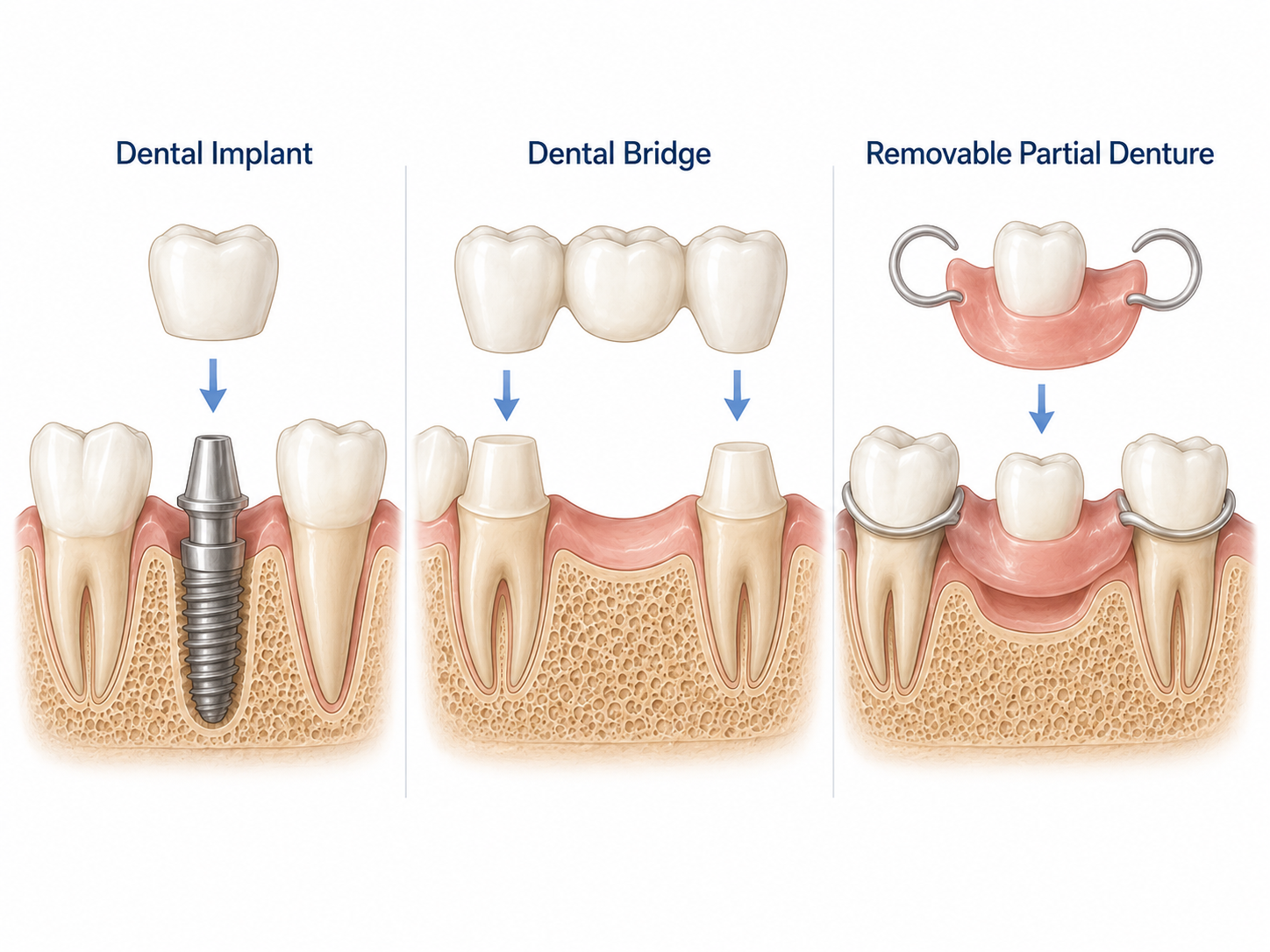
Caption:
Common ways to replace a missing tooth include an implant, bridge or removable partial denture.
Sometimes: No Replacement
Yes—sometimes monitoring the area may be reasonable.
But that decision should be deliberate rather than accidental.
There is a big difference between saying:
“My dentist assessed the area and we decided not to replace it.”
and:
“I ignored it for ten years because it was not hurting.”
“But It Doesn’t Hurt….
This is probably one of the most common reasons people delay treatment.
And it is understandable.
If something is:
not painful
not visible
not affecting daily life
it does not feel urgent.
But many of the changes associated with tooth loss are gradual.
Teeth can shift slowly.
Bone can remodel slowly.
Your chewing pattern can change slowly.
By the time you notice the difference, restoring the area may require more treatment than it would have earlier.
When Should You Ask Your Dentist About It?
Consider having the area evaluated if:
you recently lost a tooth
you have had a missing tooth for several years
nearby teeth seem to be moving
food constantly becomes trapped near the space
your bite feels different
you are chewing primarily on one side
you are considering an implant
you simply do not know whether the tooth needs to be replaced
An examination and appropriate X-rays can help determine what is happening beneath the surface.
The Tooth Factory Takeaway
A missing tooth is not simply an empty space.
It can affect the teeth beside it, the tooth opposite it, the bone underneath it and the way your entire bite functions.
That does not mean every missing tooth requires immediate replacement.
It means the decision deserves a proper assessment.
If you have a missing tooth, ask your dentist one simple question:
“If we leave this space alone, what do you expect to happen over the next five or ten years?”
That question can help you make a much more informed decision.
References
American Dental Association. Missing Teeth. MouthHealthy.
Kondo T, et al. Current perspectives of residual ridge resorption: Pathological activation of oral barrier osteoclasts.
Bodic F, et al. Bone loss and teeth. Joint Bone Spine.
About The Tooth Factory
The Tooth Factory exists to make dentistry easier to understand.
Explore more evidence-based dental education, patient information and professional resources at:
