Should Dentistry Stay Private—or Become Public?

Should Dentistry Stay Private—or Become Public?
The uncomfortable question about who should pay for your smile
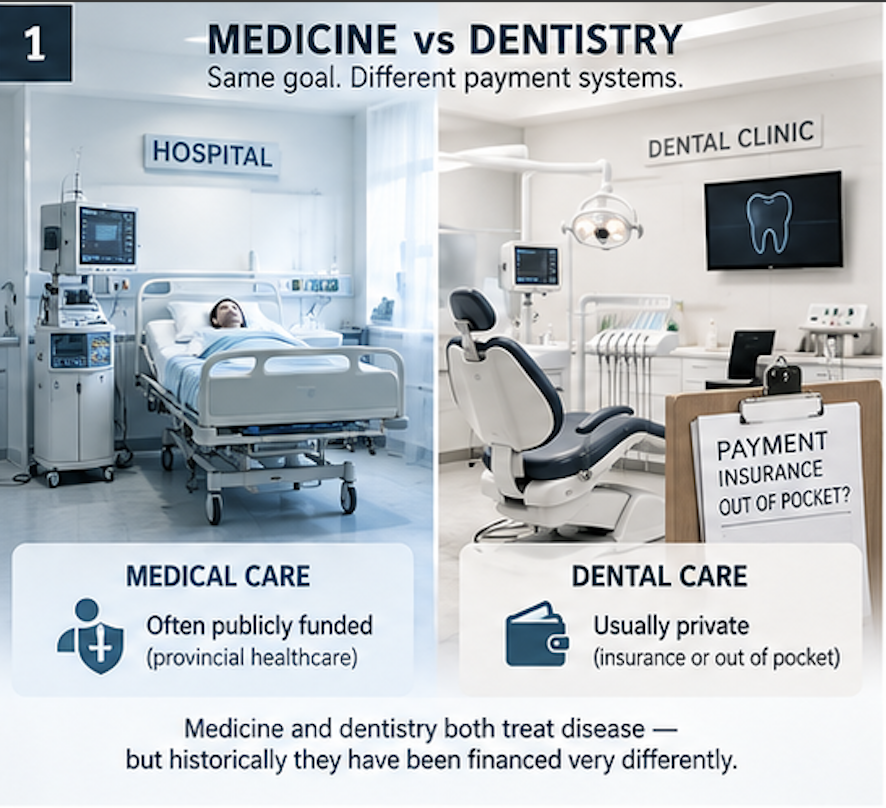
Imagine waking up tomorrow with severe abdominal pain.
You go to the hospital.
Now imagine waking up with severe dental pain.
You call a dental office.
In Canada, those two experiences can involve very different financial conversations.
That raises a surprisingly difficult question:
If oral health is part of health, why has dentistry traditionally been treated so differently from medicine?
Should dentistry remain primarily private?
Should governments pay for more of it?
Should dental clinics actually become part of a publicly operated healthcare system?
Or is the best answer somewhere in between?
The Tooth Factory wanted to examine both sides.
First: What Does “Public Dentistry” Actually Mean?
This debate becomes confusing because people often combine two completely different questions.
Question 1: Who Pays?
Dental care can be financed through:
- patients paying directly
- private dental insurance
- employer benefits
- government programs
- some combination of these
Question 2: Who Actually Provides the Care?
A dentist could work in:
- a privately owned dental office
- a corporate dental group
- a university clinic
- a community health centre
- a government-operated clinic
- a hospital
Those are not the same issue.
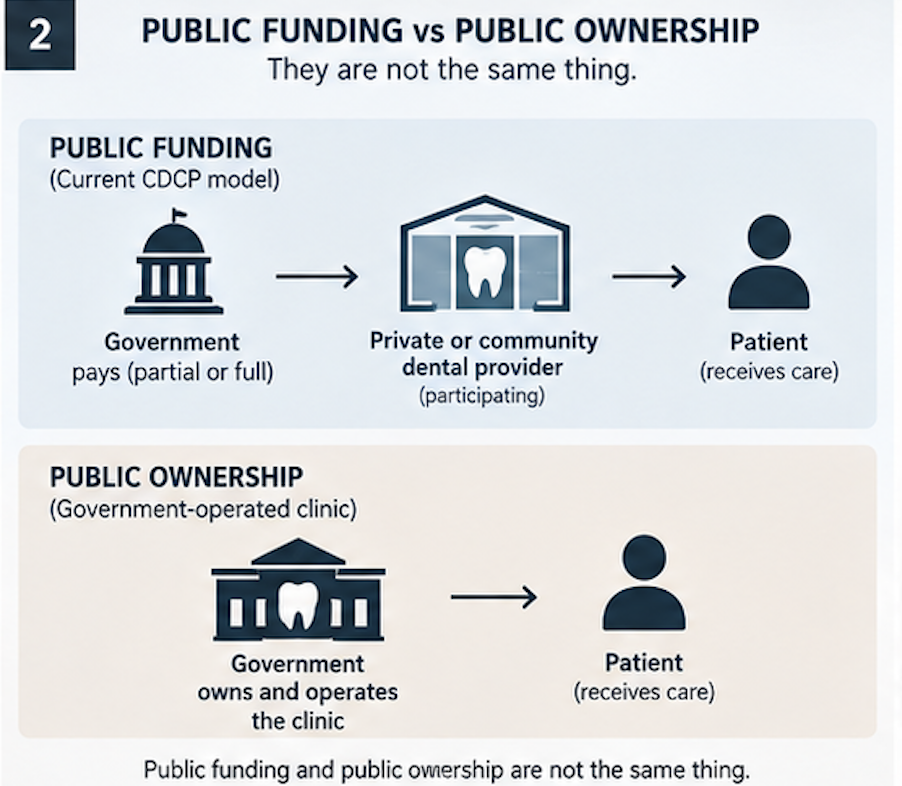
Publicly funded dentistry does not automatically mean government-owned dental offices.
Canada's current dental-care expansion is a good example.
Under the Canadian Dental Care Plan, eligible patients can receive government-supported dental coverage while continuing to visit participating dentists, hygienists, denturists and specialists in ordinary dental settings.
The government helps finance the care.
The dental professional still delivers it.
That is a hybrid model—not complete nationalization of dentistry.
The Argument for More Publicly Funded Dentistry
The strongest argument is simple:
People should not have to choose between dental disease and paying their bills.
Cost continues to prevent Canadians from obtaining oral healthcare.
In the 2024 Canadian Oral Health Survey, approximately one in four people aged 12 and older reported avoiding an oral-health professional because of cost.
The problem was substantially worse among people with lower incomes.
People also reported declining recommended treatment because they could not afford it.
That means the question is not theoretical. Some dental disease goes untreated because patients cannot pay for care.
Prevention Can Become Treatment When Care Is Delayed
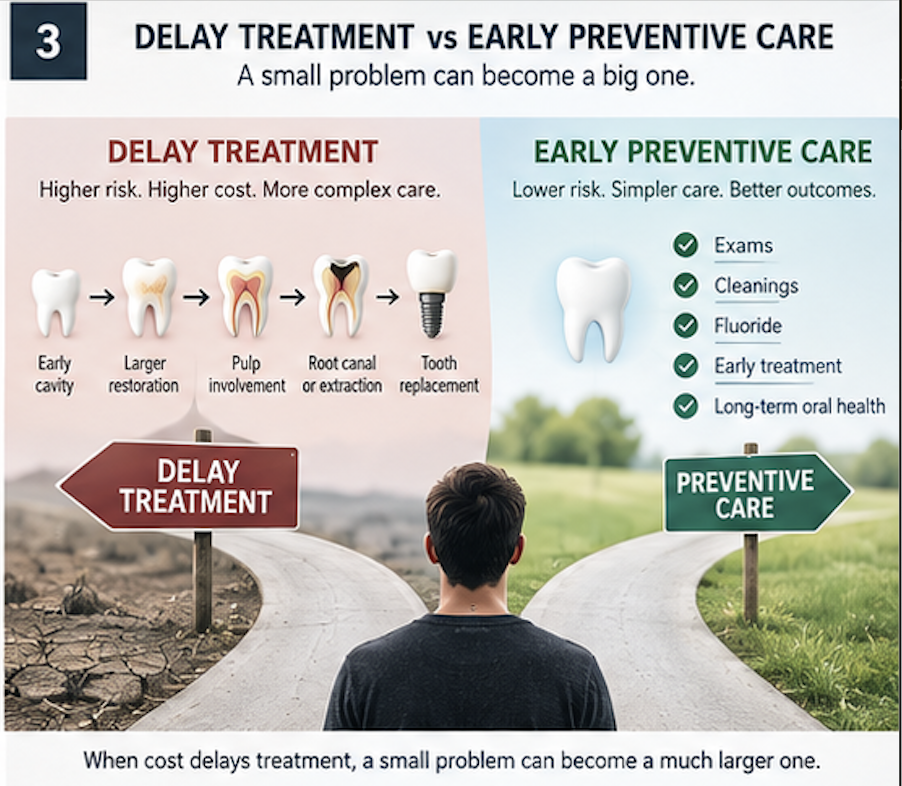
A small cavity does not remain small forever.
Untreated decay can progress from:
early cavity → larger restoration → pulp involvement → root canal or extraction → tooth replacement
The longer disease progresses, the more complicated—and often more expensive—the eventual treatment becomes.
Publicly supported preventive and basic restorative care could therefore help people receive treatment before disease becomes catastrophic.
Certain Populations Face More Than Financial Barriers
Access problems can be especially significant among:
- low-income families
- older adults
- people with disabilities
- rural populations
- long-term care residents
- people without employer dental benefits
In those situations, public investment may be needed not only to pay for dentistry, but also to help dentistry physically reach the patient.
Coverage is not true access if no one can actually deliver the care.
Then Why Not Make All Dentistry Public?
Because private healthcare delivery also has real advantages.
1. Dentistry Is Expensive to Operate
A modern dental office requires significant investment:
- dental chairs and delivery systems
- radiography and imaging
- sterilization equipment
- instruments and materials
- laboratories
- assistants and hygienists
- administrative staff
- rent and utilities
- software
- infection-control systems
- ongoing equipment maintenance
Someone must ultimately pay those costs.
Public funding does not make dentistry free. It transfers more of the bill from the individual patient to taxpayers and public budgets.
2. Private Competition Can Encourage Innovation
Dental practices compete for patients.
That can encourage investment in:
- new technology
- better patient experience
- evening and weekend hours
- digital dentistry
- new treatment options
- specialized services
A completely centralized system could risk reducing some of those market incentives if it is poorly designed.
3. Government Budgets Have Limits Too
A publicly funded dental system still needs to decide:
- which treatments are covered
- how much providers are paid
- how frequently services are covered
- which treatments require preauthorization
- what patients must pay themselves
Those decisions can create a different type of access problem.
Instead of:
“I cannot afford treatment.”
the problem can become:
“The system does not cover it, the provider does not participate, or I have to wait.”
Neither problem should be ignored.
Making something publicly funded does not automatically make access unlimited.
Maybe “Private or Public?” Is the Wrong Question
Healthcare debates often force us into two boxes:
Option A: Private dentistry.
Option B: Government dentistry.
But many successful healthcare systems operate somewhere between those extremes.
Consider a different model.
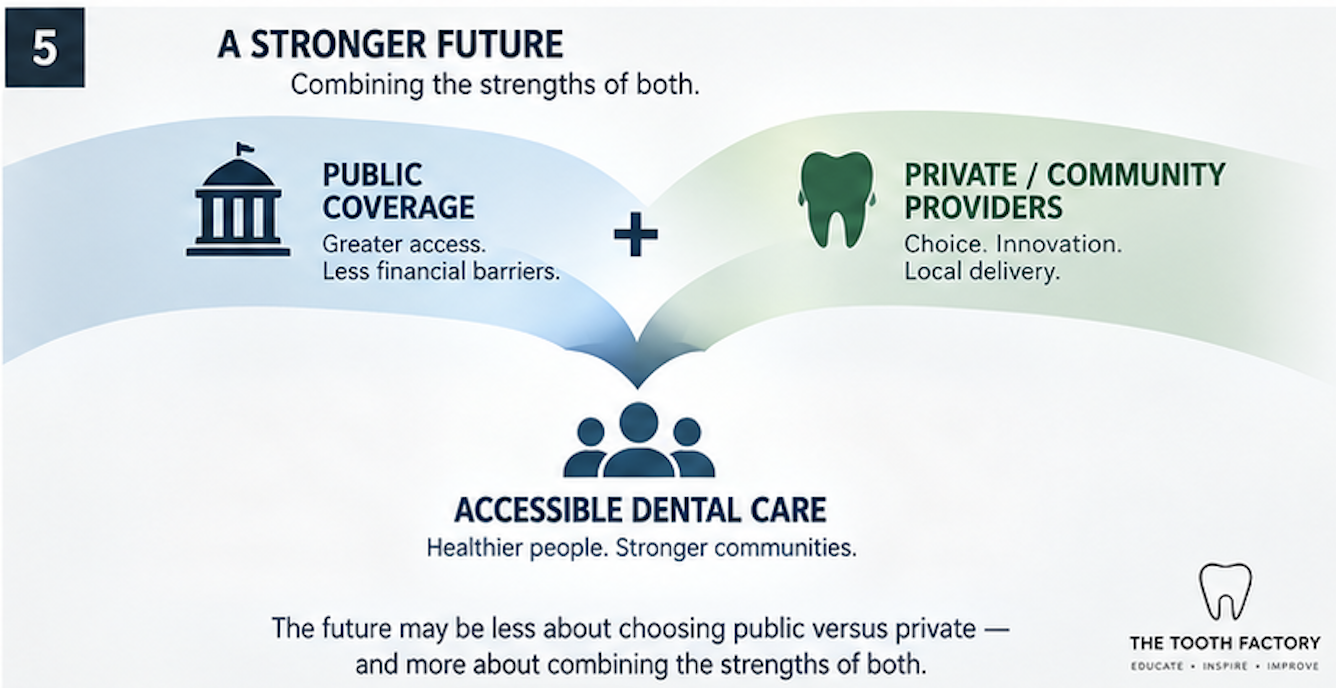
Publicly guarantee essential oral healthcare while allowing a diverse private and community-based dental system to deliver much of it.
Government support could focus heavily on services with clear health and functional value:
- examinations
- diagnostic imaging
- preventive care
- periodontal care
- basic restorations
- pain and infection management
- necessary endodontic care
- necessary extractions
- basic prosthetic rehabilitation
Greater support could be targeted toward populations with the greatest barriers:
- children
- low-income adults
- seniors
- people with disabilities
- long-term care residents
- rural and remote populations
At the same time, private dentistry could continue providing expanded choice, premium services, cosmetic treatment and treatments beyond publicly funded benefit packages.
Public safety net. Private delivery. Patient choice.
Should Every Dental Procedure Be Publicly Funded?
Probably not.
This is where dentistry becomes more complicated than the slogan:
“Dental care is healthcare.”
A patient with an odontogenic infection clearly has a health problem.
A child with extensive caries clearly needs treatment.
A senior unable to chew because of missing teeth has a functional problem.
But dentistry also includes elective and cosmetic treatment.
Should taxpayers fund:
- tooth whitening?
- elective veneers?
- cosmetic smile redesign?
- premium implant options in every situation?
Probably not automatically.
A sustainable public system therefore needs boundaries.
The real debate is not whether every dental procedure should be free.
It is whether every person should have reasonable access to a basic standard of medically and functionally necessary oral healthcare.
The Tooth Factory Takeaway
So should dentistry remain private?
In our view, private dentistry still has an important role.
Competition, professional independence, patient choice and entrepreneurship have helped dentistry innovate rapidly.
But a system in which significant numbers of people avoid necessary treatment because of cost also deserves scrutiny.
The answer may therefore not be complete privatization or complete government ownership.
The stronger model may be universal access to essential oral healthcare delivered through a mixed public-private system.
Let private practices continue to innovate.
Let patients continue to choose their providers.
Let dentists maintain professional independence.
But build a stronger safety net so that income, age, disability or geography do not automatically determine whether disease is treated.
Because perhaps the goal should not be:
public dentistry versus private dentistry.
Perhaps the goal should simply be:
accessible dentistry.
A Question for You
If essential medical treatment is publicly supported, should basic dental treatment be treated the same way?
Or would greater government involvement ultimately make dental care less efficient?
The answer may shape what dentistry looks like for the next generation.
About The Tooth Factory
The Tooth Factory makes dentistry easier to understand while exploring the clinical, technological and policy questions shaping the future of oral healthcare.
We publish two free dental and oral-health articles every week.
www.thetoothfactory.ca
YouTube: @TheToothFactory
References & Further Reading
1. Health Canada. Canadian Oral Health Survey — Access to Oral Health Care.
2. Health Canada. Bridging the Gap: A Look at Oral Health and Access to Care in Canada Before the Canadian Dental Care Plan.
3. Government of Canada. Canadian Dental Care Plan — Information for Oral Health Professionals.
4. Government of Canada. Canadian Dental Care Plan — Coverage and Dental Benefits Guide.
5. OECD. Health at a Glance — Extent of Healthcare Coverage.
